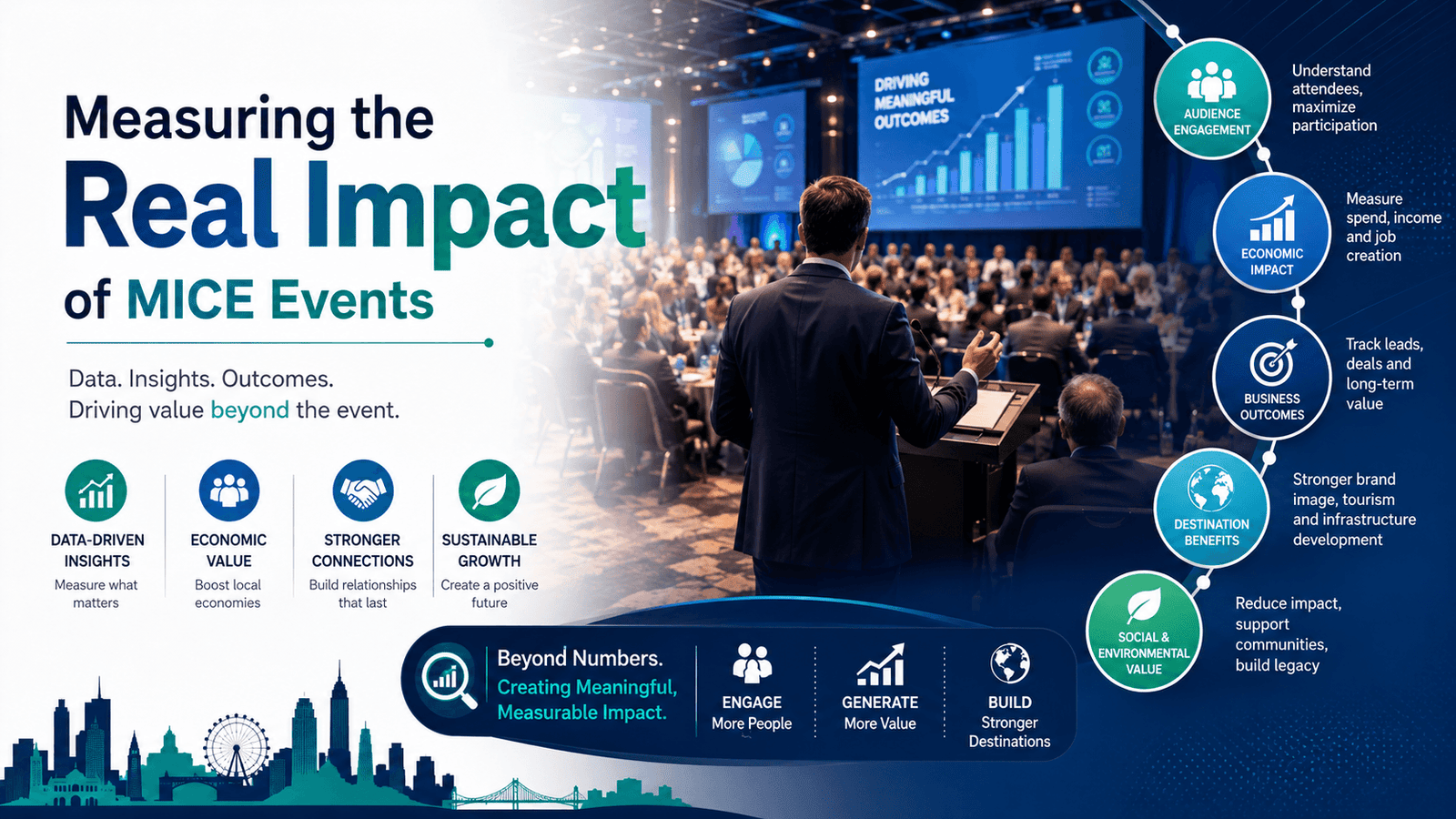
A successful MICE event is often measured by attendance, revenue, delegate satisfaction, and media visibility. But the real value of an event can go much further.
A conference, association meeting, exhibition, or incentive programme can influence local businesses, employment, knowledge exchange, community participation, destination branding, and environmental performance. The challenge is that these outcomes are rarely documented systematically.
From Event Execution to Event Legacy
The question should no longer be only:
“How successful was the event?”
It should also be:
“What did the event leave behind?”
Melbourne provides a strong example. Over the past decade, Melbourne Convention Bureau reports that 1,620 business events generated A$2.34 billion in economic contribution, 1.3 million hotel room nights, and an estimated 29,000 jobs. Its impact reporting also highlights outcomes in education, investment, knowledge exchange, community engagement, and international collaboration.
This demonstrates why measuring MICE impact should extend beyond the event venue.
The Triple Impact of an Event
A responsible event should examine three dimensions:
Economic Impact
How much did the event contribute to hotels, restaurants, transport, local suppliers, attractions, employment, and the wider destination economy?
Social Impact
Did local communities participate? Did the event create learning, networking, employment, inclusion, or opportunities for young professionals and local businesses?
Environmental Impact
What were the event's carbon emissions, energy consumption, waste generation, water use, travel footprint, and resource requirements?
The current ISO 20121:2024 standard specifically encourages event organizations to manage social, economic, and environmental impacts and to consider long-term event legacy.
Events Can Create Long-Term Change
The London 2012 Olympic Games were an early large-scale demonstration of this approach, using ISO 20121 to integrate sustainability into event planning and legacy.
More recently, Paris 2024 reported a carbon footprint of approximately 1.59 million tonnes of CO₂e, claiming a reduction of more than 50% compared with the average footprint of the London 2012 and Rio 2016 Games. The event also welcomed around 12.1 million spectators.
These examples show that large events can become platforms for measurable environmental action and destination legacy, rather than temporary gatherings.
What Should MICE Destinations Measure?
A practical event impact report can capture:
- Visitor economy: delegates, room nights, visitor spending and local business participation
- Economic contribution: direct and indirect economic activity
- Social impact: community participation, employment, inclusion and knowledge transfer
- Environmental performance: carbon emissions, waste, water, energy and transport
- Visitor experience: satisfaction, behaviour and destination journey
- Legacy: partnerships, investments, skills, community initiatives and future business generated
The DTORR Perspective
At DTORR, we believe every significant event should leave a documented footprint—not just an operational report.
Using research, surveys, technology-enabled data collection and impact assessment, MICE events can become measurable instruments for destination development, responsible business, community benefit and sustainability.
Because the success of an event should not end when the delegates leave.
The real success is the impact that remains.